Three Ways Up: Picking Low-Level Access Kit That Suits the Job

Photo: Mark Warren 1973, CC BY-SA 4.0, via Wikimedia Commons
Ask three maintenance teams how they reach a ceiling void at three metres and you will get three answers, usually delivered with total confidence and for no better reason than that is what lives in the store cupboard. Habits are efficient. They are also occasionally expensive, and sometimes unsafe.
The awkward middle ground — roughly two to four metres of working height — is where most facilities work sits. Changing a filter, swapping a lamp, chasing a leak in a plant room ceiling, checking a smoke detector, clearing a low gutter. All of it is short in duration and unglamorous, and all of it involves a fall risk that the Working at Height Regulations 2005 apply to just as firmly as they apply to a roof.
So it is worth comparing the three usual suspects properly. Below is a plain look at what each one is good at, what it costs, and where it quietly falls down.
Podium steps: the twenty-second solution
A folding platform with guardrails, usually with a platform height somewhere between one and one and a half metres and a working height around three. Modern versions fold flat enough to wheel through a doorway and park in a cupboard.
Setup time is measured in seconds, not minutes. One trained person can handle it. Day rates are modest — think somewhere in the region of fifteen to forty pounds at 2026 prices, with weekly rates that make a multi-day job sensible. Many teams eventually buy a pair rather than hire.
Where it wins: quick, repetitive, small-footprint tasks on firm, level, finished floors. A plant room, a corridor, a shop floor, a school hall.
Where it fails: anything that needs lateral reach or a run of work. You cannot span a desk, a duct or a stairwell. You will be climbing down and repositioning constantly. There is little room for materials, and the working platform is not designed for a long shift.
Mobile towers: flexible, but they want your time
A mobile access tower gets you higher and wider than a podium, and can span obstacles that would defeat one. Erected properly by a trained person — PASMA is the usual benchmark — a tower gives a generous platform, guardrails, toe boards and room for a second person plus tools.
Erection is the trade-off. A small tower might take ten minutes with two people who know what they are doing; a larger one considerably longer, and the components are heavy, awkward and need somewhere to live. Storage is a genuine constraint in a building with no yard. Wind is another: a tower is a sail, and an internal tower near a loading bay door in February is not the same proposition as one in a sealed corridor.
Expect roughly fifty to a hundred and twenty pounds a day depending on size and configuration, with weekly deals worth asking about. Towers are also the option most often misused — never add a platform, never bridge two towers, never move one with someone at height.
Where it wins: work along a run, jobs needing more space, spans, and anything where a podium is simply too low or too cramped.
Where it fails: short jobs. If the task is five minutes of work, half an hour of erecting is a poor return, and that is precisely when shortcuts start creeping in.
Scissor lifts: productivity with a price tag
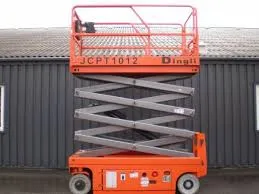
An electric slab scissor lift is the grown-up option. Platform heights of five or six metres are common, with micro and compact models down to three or four that will fit through a double doorway. IPAF 3a is the usual operator category.
Setup is minutes: drive in, check the ground, press go. For anything repeated across a shift, the time saving is dramatic compared with a tower, and the platform carries two people and a decent pile of kit. Stability and comfort are in a different league.
Costs are higher — broadly eighty to two hundred pounds a day depending on size, plus delivery and collection, which can comfortably equal a day's hire on its own if you are off the beaten track. A weekly rate usually changes the maths.
Where it wins: sustained work, high ceilings, heavy kit, and any job where you would otherwise be building and dismantling a tower three times a day.
Where it fails: floors. A scissor lift wants a decent slab, and on a suspended or mezzanine floor you need the floor loading confirmed before anything is driven onto it. It also needs somewhere to park and charge, and it is not a one-person piece of kit in practice — someone on the ground needs to know the rescue plan.
The four questions that actually decide it
How often? A one-off twenty-minute task points at podium steps every time. Daily work over a fortnight makes a scissor lift cheaper in real terms once you cost the erection hours. Somewhere in the middle, a tower earns its keep.
What is the floor like? Finished flooring, carpet tiles and vinyl favour podium steps or a scissor lift with clean tyres. Rough external ground favours none of the three, and you should be looking at a different machine entirely.
Who else is there? Podium steps and towers can be used by a single trained person. A scissor lift needs someone on the ground who is aware and competent, and lone-working policies in larger organisations often rule it out for evening shifts.
What does the risk assessment say? Run the hierarchy properly: avoid the work at height if you can, prevent a fall if you cannot, minimise the consequences if you must go up. Low level is not a free pass — injuries from sub-two-metre falls are common and entirely avoidable.
The habit trap
None of these options is wrong. The problem is choosing one because it is already in the van. A team that defaults to towers will lose hours on trivial jobs, and a team that defaults to podium steps will eventually improvise something they should not. Match the kit to the task, write the reason down, and the decision stops being a personality trait.