Twelve Things to Settle Before a Winter MEWP Hire Lands on Your Yard
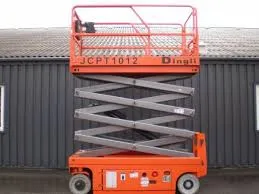
Photo: Delfadenko, CC BY-SA 4.0, via Wikimedia Commons
Winter hires have a habit of going sideways. Not usually because the machine is wrong — most platforms are sound — but because nobody asked the awkward questions while there was still time to change the order. Frozen ground that turns to soup by ten in the morning, a battery that was fine in September and now sulks at two degrees, a delivery slot that clashes with the only person on site holding an in-date IPAF card. None of this is exotic. All of it is avoidable.
Below is the run-through we would use before confirming any mobile elevating work platform hire between now and spring.
Ground conditions: questions 1 to 3
1. What is actually under the machine? Ask for a proper ground-bearing conversation rather than a guess. Tarmac that has been dug up and patched, block paving laid over old services, a concrete apron with a drain cover sitting dead centre — all of it matters. Outriggers concentrate load into small patches, and a frost-heaved slab is not the same slab you walked across in July.
2. Will the route in survive a wet fortnight? A tracked machine will shrug off a muddy compound. A wheeled scissor lift on turf in December will not, and you will spend the morning digging it out rather than working from it. If the only way to the work area is across grass or freshly landscaped ground, say so before the order goes in and ask about trackway, mats or an alternative machine.
3. Has anyone walked the site, or are we going off a photo? Most hire desks will do a site survey or at least a video call these days. Use it. Fifteen minutes of that is cheaper than a machine that arrives and cannot get past the gate.
Cold-weather power: questions 4 to 6
4. What is the realistic duty cycle at two degrees? Battery performance drops in the cold — noticeably so on lead-acid, less brutally on lithium. Ask what run time the hire company would genuinely expect on a cold day with a work light running, not the brochure figure measured in a warm room.
5. Where is the charging point, and is it actually live? A 110V site supply, a 240V socket in a plant room, or a generator — decide now rather than at four in the afternoon. Charging a scissor lift from a genny that is already carrying half the site is a reliable way to own a machine that never quite reaches full.
6. What charge will it arrive with? Ask for it delivered fully charged and check the gauge at handover, with the driver still there. If it turns up at forty per cent and your first job is a two-hour ceiling run, the day has already gone.
People and paperwork: questions 7 to 9
7. Whose cards, which categories, and are they in date? MEWPs are category-specific: a 3a scissor lift ticket does not cover a 1b or a 3b. Check the physical or digital card on the day, not a photo in a group chat from last winter.
8. Who is doing the familiarisation, and will they be on site at seven? Handover familiarisation is not the same thing as training. It is the hire company's job to walk through the controls, the emergency lowering and the quirks of that particular machine — and someone competent needs to be there to receive it.
9. Is there a rescue plan, and does it actually work? Emergency lowering is the bit everyone skips. Know where the lever or auxiliary pump is, know who is on the ground, and know what happens if the operator is the person who needs help. A sentence on the RAMS is fine if it is accurate and someone has read it.
Delivery, collection and the clock: questions 10 and 11
10. What is the delivery window, who signs, and can the wagon get in? Narrow streets, permit bays, a barrier that needs a fob, a loading bay booked until nine. Sort it before the low loader is rolling, not while the driver is ringing you from the end of the road.
11. What is the off-hire process, and what happens if the job overruns? Weekends and bank holidays quietly add days to the bill. Ask about the cut-off for amending collection, and whether the machine can sit on site over the Christmas break without a standing charge attached.
The photographic bit: question 12
12. What is the damage protocol, and what do we photograph before signing? This is the one that saves arguments six weeks later. Before the driver leaves, photograph the machine from all four corners, the platform deck and gate, the tyres or tracks, the hour meter, the battery gauge, every warning decal, and the LOLER certificate or declaration of conformity if it travels on the machine. Put something in shot for scale if there is pre-existing damage — a boot, a glove, a tape measure. Timestamp it all. Ten minutes now beats a three-month disagreement about a dent nobody remembers.
And then there is the wind
Ask what the manufacturer's wind limit is for the machine, whether there is an anemometer onboard, and who has the authority to call a stop. In a UK winter, gusts are what end a day early, and it is far easier to agree that protocol in a warm office than halfway up a platform with a sign flapping.
The twelve, in short
- What is the ground like where it will stand?
- Will the access route survive two weeks of rain?
- Has anyone actually surveyed the site?
- What is the real cold-weather run time?
- Where is the charging supply?
- What charge will it arrive with?
- Whose IPAF cards, which categories, in date?
- Who receives the familiarisation, and when?
- Is the rescue plan written and workable?
- What is the delivery window and who signs?
- How does off-hire work if the job slips?
- What do we photograph before signing?
None of this is glamorous, and none of it takes long. But a winter hire that starts with twelve answered questions tends to finish with a machine going back on the wagon rather than a phone call to the insurer.