Charge Windows, Not Tea Breaks: Keeping Electric MEWPs Alive Across a Long Hire
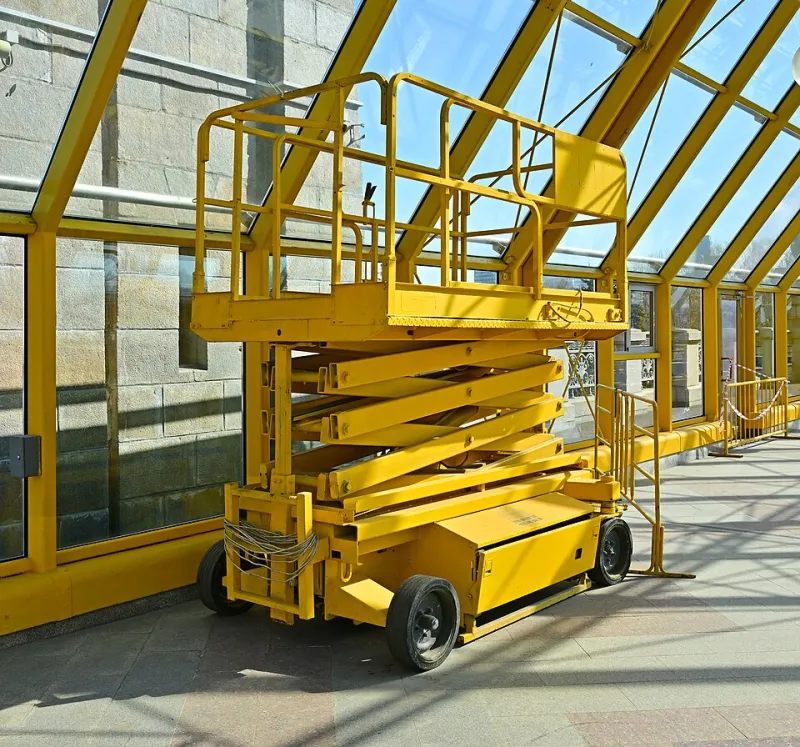
Photo: Юрий Д.К., CC BY 4.0, via Wikimedia Commons
Electric access platforms have quietly taken over indoor work, and rightly so. No diesel, no fumes in a sealed unit, no run to the forecourt at half seven in the morning. The catch is simple: the battery has a fixed amount of patience, and the job rarely respects it.
A multi-day hire turns that into a planning problem rather than a nuisance. Here's how to keep the machine working instead of sitting on a lead.
1. Do the duty-cycle maths before you book
A scissor lift rated for a full shift is rated for a particular kind of shift. Long travel runs across a warehouse floor, constant up-and-down, and heavy tools running off the platform all eat into it. Before you confirm the hire, sketch the day: how many hours of movement, how many operators, how far the machine travels between tasks. If the answer is 'most of the day, mostly moving', you want a bigger battery or a different machine — not optimism.
2. Treat 30 per cent as your zero
Battery gauges lie by omission. A lead-acid pack run down to 10 per cent repeatedly will lose capacity over the hire, and the machine you hand back won't be the machine you signed for. Work to a rule: anything under about 30 per cent goes on charge, not out on another run. That buffer also covers the last job of the day, which always takes longer than anyone planned.
3. The charge window is a shift nobody wants to work
A flooded lead-acid pack typically wants eight to ten hours on charge, plus cooling time before it's topped up again. That is a full night. If your site closes at five and opens at seven, you have fourteen hours — fine, as long as someone actually plugs it in and no one unplugs it to use the socket for a kettle.
Name the person. Put it on the handover sheet. 'Someone will do it' is how machines arrive on Tuesday morning at 40 per cent.
4. Match the charger to the building, not the nearest socket
Cable routes are where good intentions meet trip hazards. A few things worth deciding in advance:
- Where the charger lives, and whether that spot blocks a fire exit, a thoroughfare or a loading bay at 6am.
- Whether the supply is RCD-protected and rated for the charger's draw.
- Extension leads: long, thin leads cause voltage drop and heat. Use the correct gauge, keep runs short, and never daisy-chain.
- Cable ramps or a protected route across walkways — a trailing lead at ankle height is a claim waiting to happen.
- Ventilation if you're charging lead-acid indoors. Those packs give off hydrogen while charging, and plant rooms with no air movement are not the place.
5. Cold weather doesn't just affect the operators
Battery capacity drops in low temperatures, and it drops faster than most people expect. An unheated shell of a building in January can knock a noticeable chunk off a shift. Charging in the cold slows the process too, so a pack that takes nine hours in June might want eleven in February.
If you're working in a cold structure, charge somewhere warmer if the machine can reasonably get there, or accept a shorter working window and plan the day around it.
6. Two-shift days need two machines
Double-day working and electric scissor lifts don't naturally get on. If the site runs 6am to 10pm, one machine cannot be both in use and on charge. Options: a second machine on hire, a lithium machine that tolerates opportunity charging, or shifting the heavy work into a single window. Deciding this on day one costs a phone call. Deciding it on day four costs a lost shift and a conversation with the hire desk about who pays.
7. Know your chemistry
- Flooded lead-acid: the workhorse. Cheap, heavy, needs watering on longer hires, hates deep discharge, charge it properly and fully.
- AGM or gel: sealed, less maintenance, similar charging discipline.
- Lithium-ion: lighter, faster to charge, and generally happy with top-up charging between tasks. Not every hire fleet has them, and they carry a premium — but on a tight multi-day programme they often pay for themselves in availability.
Ask the hire desk which chemistry you're getting. It changes how you plan the day more than any other single fact.
8. Watch for the machine that has already given up
The warning signs arrive before the shutdown:
- Travel speed noticeably slower than on day one.
- Lift and lower sluggish, or the machine cutting out under load.
- The gauge dropping several bars in minutes rather than hours.
- A battery pack that is hot to the touch after charging, or one that never seems to reach full.
- Fault codes on the charger, or a charger fan that has stopped.
- Charge times creeping longer while working hours get shorter.
Any of those is a phone call to the hire firm, not a note in the diary. Battery faults get worse, never better, and a machine that dies mid-task with a person in the basket is a rescue situation you don't want to create.
9. Log the gauge, not just the hours
A five-second entry at shift start and end — hour meter reading, percentage on the gauge, who charged it and when — gives you something to show the hire company if there's a dispute about a failing battery. It also exposes the real pattern. Two weeks of notes will tell you whether the machine is short on capacity or the night shift keeps unplugging it.
The short version
Plan the charge window like a shift, keep a 30 per cent floor, put the charger somewhere sensible with a protected cable route, and treat a slow machine as a warning rather than a personality trait. Electric access kit is genuinely better for indoor work — it just doesn't do overtime for free.