Open for Business: Renting Access Kit for Buildings That Can't Shut Down
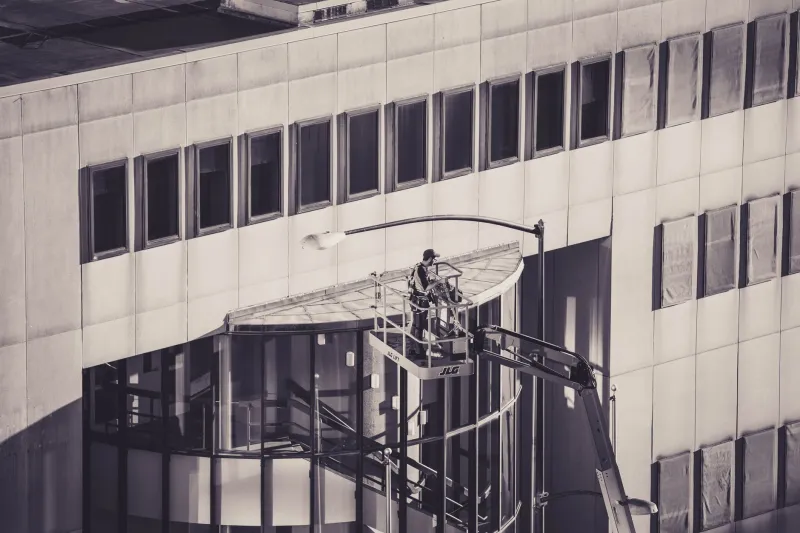
You can plan a lift down to the last outrigger pad and still lose the day to a coffee queue. Work in an occupied building is rarely beaten by the height; it's beaten by the building's routine — the 8:47 lift surge, the 10:15 fire door check, the delivery that needs the goods lift at eleven. Hiring access equipment for a live office, shop, school or library is a scheduling exercise as much as a technical one, and the questions that save the job tend to get asked before the machine leaves the yard.
The building's diary comes before the hire catalogue
Before you compare platform heights and widths, ask the facilities manager to talk you through a normal day: when staff arrive, when the public is busiest, when cleaning and security change shift, when deliveries are booked, and who owns the fire risk assessment. A machine that turns up at 07:30 when the concierge clocks on at eight is a machine parked somewhere it shouldn't be. A delivery that lands in the school run is a phone call you'll take twice.
Get the working window in writing, along with the name of the person who can change it. In shared buildings the person who books the contractor is often not the person who controls the loading bay, and those two rarely speak unless someone makes them.
Barriers that survive the lunchtime rush
Cones and hazard tape are a suggestion, not a barrier. In a live building you want something physical between the public and the work zone, plus a banksman who is actually watching the route rather than the machine. Sign both ends of the walkway, not just the far end, and put a notice at the lift lobby where people decide which way to go.
Two things catch people out. First, the alternative route: if your diversion pushes pedestrians into a vehicle movement area, a dark stairwell or a narrow corridor, you've moved the risk rather than removed it. Second, escape width. A segregated walkway that leaves a metre of clear corridor is fine on paper and useless when a wheelchair user needs it, so measure rather than estimate.
Fire safety is the one you can't improvise
Never block or narrow a means of escape, never prop a fire door, and never stack materials in a protected route. Under the Regulatory Reform (Fire Safety) Order 2005 the responsible person for the building has to keep the escape strategy working, and that includes the weeks when a scissor lift is parked in the corridor.
If the job changes the building's arrangements even temporarily, put it in writing with that responsible person and keep a copy in the site file. The classics are worth naming because they happen every week: charging a machine on a protected landing, storing LPG cylinders in a corridor, and running an extension lead through a fire door. If the answer to 'is that allowed?' is a shrug, the answer is no.
Work to the building's clock
The noisy twenty per cent of the job — core drilling, tile removal, hammer action — is what empties a shop floor or disrupts a classroom. Ask what hours the lease or the building rules permit, then consider pushing that phase into an evening or weekend and keeping the quiet work in hours. Out-of-hours hire rates, temporary lighting, lone working rules, alarm codes and a security escort all need sorting before you book that shift, not on the day.
Dust travels further than noise in most buildings because it gets into the ventilation. Sheeting, extraction on the tool and a quick conversation with the person who runs the building management system will do more than a sign saying sorry for the inconvenience.
The people who share the space
Reception, cleaners, security and the tenant on the floor below are the ones who will make or break the day. A one-page notice at the lifts with dates, working hours and a mobile number does more than three emails. Tell the cleaners specifically — they arrive at six and will happily move your barriers to get to a bin.
Name one contact on your side who can say yes to a change. Nothing stalls a live-site job faster than a subcontractor waiting for permission from someone who is in a meeting until two.
What to put to the hire desk
- Delivery and collection windows, and whether an out-of-hours drop is priced separately
- Electric or hybrid options, plus where the machine will actually be charged — a 13A socket in a corridor is not a charging strategy
- Overall width and weight, and the point loads it puts through wheels or pads, for the floor you're crossing
- Non-marking tyres and confirmation the machine is rated for indoor use
- Whether it fits the goods lift: measure the lift, not the doorway, and check the weight limit
- Familiarisation at handover, and who delivers it — your operator or a driver on a tight schedule
- The IPAF category for the machine against the card you hold, or PASMA for a tower
- Public liability and plant cover, the damage waiver, and who pays if the lobby floor gets marked
- Fuel policy and spill kit, and whether refuelling indoors is permitted (usually it isn't)
The folder the facilities manager will ask for
Risk assessments and method statements, insurance certificates, card copies, contractor induction, permit to work, hot works permit if it applies, waste transfer notes and sign-in sheets. It looks like paperwork until the first morning, when the security desk won't let you past without it.
A morning that actually works
- Machine arrives inside the booked window, signed in and escorted to the work area.
- Walkround with the building's representative and the operator, with photographs of the floor before anything moves.
- Barriers and signage up before the first lift, not after.
- Familiarisation delivered, logged and signed.
- Notice at the lifts and reception briefed.
- Charging plan and cable route agreed so nobody trips over it at four o'clock.
The building doesn't pause
The measure of a good hire in an occupied building isn't how quickly the machine went up. It's whether the ten o'clock meeting still happened, the fire doors stayed shut and nobody had to explain to a tenant why the route to the stairs was blocked. Book the kit around the building rather than expecting the building to move around the kit, and a live site stops being a complication and starts being just another Tuesday.