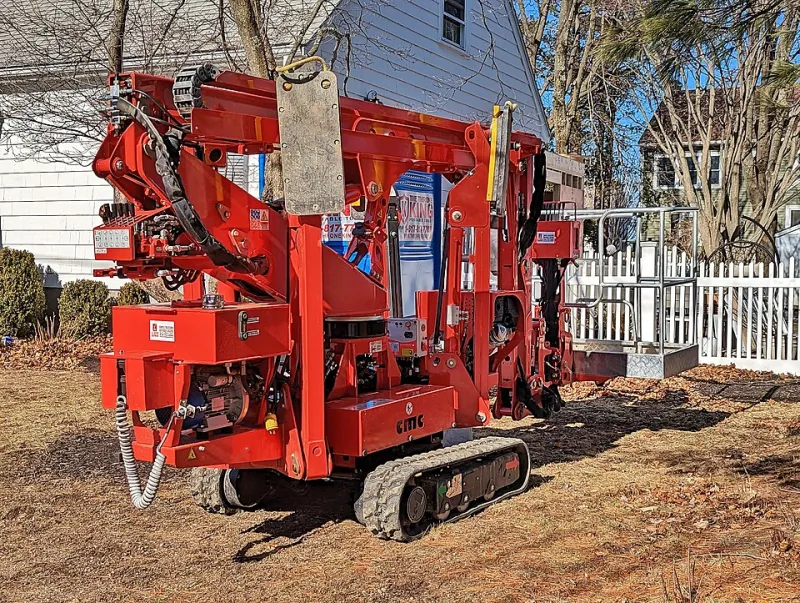
The Ground Under the Outrigger: Why 'It Looks Solid' Isn't a Load Calculation
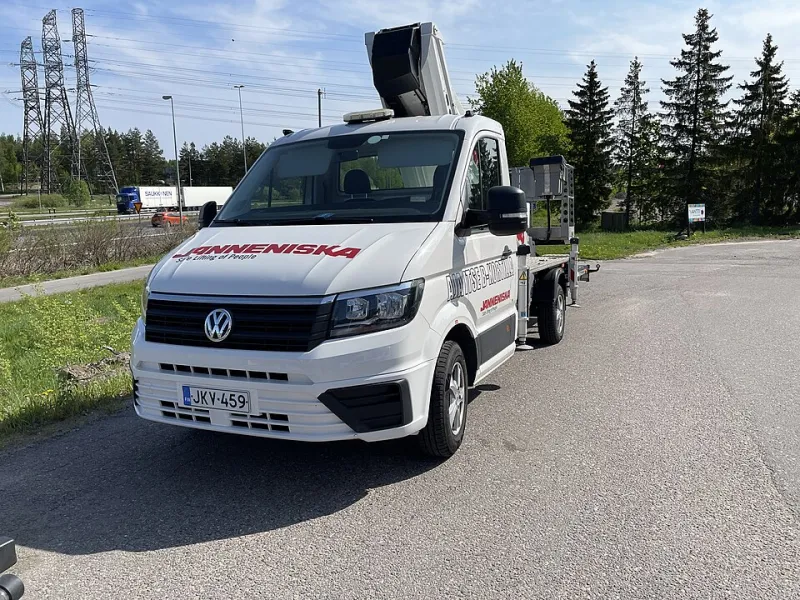
Photo: Ypsilon from Finland, CC0, via Wikimedia Commons
There's a particular kind of confidence that comes from standing on a bit of hardstanding and saying 'that'll hold'. It usually does. The trouble is that the failures, when they happen, aren't gradual — a leg punches through a void, a slab gives, a paving edge crumbles, and a machine that was level thirty seconds ago is leaning at an angle nobody wants to photograph.
Ground conditions are the least glamorous part of access work and the first thing skimmed in the pre-use check. Which is odd, because it's the only thing between the machine and gravity.
A dinner-plate pad carrying a van
An outrigger pad on a mid-size boom is often not much bigger than a large dinner plate. Through that small area goes a share of the machine, the basket load and the dynamic forces of somebody slewing at full reach. Point loading is the phrase to remember: a static figure can easily double under movement, and a machine on a camber puts more through one leg than the other three combined.
So the questions worth asking are simple even if the answers aren't. What's the maximum ground pressure at each outrigger, in the configuration you're actually going to use — not the brochure's best case? What's the bearing capacity of what's underneath? And is there anything buried in between?
If those numbers aren't to hand, that's the point at which you ring the hire desk or read the load chart, rather than shrugging and cracking on.
Why soft ground fails quietly
Firm-looking ground often isn't. Backfilled trenches along a new-build service run, ground that's been dug and loosely reinstated, ground near an excavation where the lateral support has gone, and ground that's simply wetter than it was last week can all sit happily under a van and fail under a loaded outrigger.
The warning signs are subtle: fresh tarmac over a trench line, a strip of block paving that's dipped, a bit of ground that squelches when you walk it, camber toward a drain. If you can see a trench, assume it's backfilled until someone proves otherwise.
When mats and spreader plates earn their keep
Spreader plates and composite mats work on one principle: spread the same load over a bigger footprint. Double the pad area and you roughly halve the pressure. That's it. It's not magic and it isn't a substitute for knowing what's underneath.
What matters in practice:
- Size the mat to the job. A random sheet of 18mm ply under an outrigger is a gesture, not engineering. Thick timber cribbing or a proper composite or steel mat, sized against the calculated pressure, is the real thing.
- No bridging. A mat laid across a void or a drain run concentrates load at the edges rather than spreading it.
- Full contact. Mats on soft ground need to sit flat, with cribbing built up properly if you're levelling. A stack of loose offcuts is a lever waiting to happen.
- Re-check after movement. Mats settle. Ten minutes after the machine goes up is the right time to look again.
The UK ground tour
Ground conditions vary wildly over short distances here, which is half the problem. A few of the regular characters:
London clay shrinks and swells with the seasons and softens fast when it's wet. Firm in August, greasy in February, and often capped with a thin layer of something that looks reassuringly solid.
Made ground is the big one on regeneration sites — brick, ash, rubble, old foundations and who-knows-what, compacted to varying degrees. It's everywhere around older industrial areas and it is genuinely unpredictable.
Peat and soft alluvium in parts of the Fens, Lancashire and the Scottish lowlands will take a machine one day and swallow a leg the next.
Chalk and limestone can hide solution features and voids, particularly in parts of the south and the Peak District.
Old workings in the Midlands, the North East and parts of Wales are mapped, but not always accurately.
Then there are the buried services. Victorian brick sewers, salt-glazed pipes, ducting, culverts and old basement vaults under pavements. Utility drawings help but they're rarely complete and rarely accurate on depth. A cable avoidance tool is a useful sanity check for metallic and energised services, but it won't find plastic pipe or a brick culvert. If the drawings and the ground disagree, a trial hole costs less than the alternative.
Pavements, block paving and covers
A footway is a designed surface for pedestrians, not for a boom lift. Block paving over a service trench is a classic failure — the blocks bridge the void beautifully until they don't. Kerb edges and the transition between footway and carriageway are weak points too.
And a manhole cover is not a load-bearing surface, no matter how many times you've seen a van parked on one. Nor is a paving slab over a cellar vault, which is a live issue across plenty of city centres.
Suspended slabs, decks and basements
Podium decks, car park decks, mezzanine floors and roof slabs have declared load capacities, and they're frequently lower than they look. 'It held a lorry once' is not a capacity figure. Get the slab rating in kN/m² from whoever owns the building and have a structural engineer confirm it before a wheel or an outrigger goes anywhere near it. This is the one area where guessing is genuinely not an option.
Slope, camber and the bits everyone forgets
Outrigger beams fully extended as per the manufacturer's instructions. Machine levelled using the bubble, not by eye. Wheels clear of the ground if the manual says so. Outriggers on a slope within the permitted limit, with the downhill legs properly bedded. And nobody standing in the drop zone while the legs go down.
Before the boom goes up
- Load chart checked for the configuration you're using
- Ground pressure calculated, not assumed
- Buried services checked against drawings, with a CAT scan as a minimum
- Trial hole if anything is uncertain
- Mats sized, flat and not bridging anything
- Slab capacity confirmed in writing if you're on a deck
- Ground re-checked after the machine is up and settled
None of it takes long. Most of it can be done with a phone call and a walk round the site. It's just the bit that gets skipped when the wagon's waiting and everyone wants to go home.